Cano Island Biological Reserve
About 12 miles
(19 km) off-shore (45 minutes) from Costa Rica's south Pacific coast
lies Caño Island Biological Reserve, 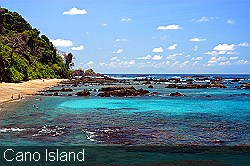 one of the Osa Peninsula’s true
gems. Year-round warm, clear waters are home to an abundance of marine
life and offer some of Costa Rica’s best snorkeling and diving. From
humpback whales and dolphins to marine turtles, sharks, manta rays and
huge schools of fish, a casual day at the island is sure to please those
in search of wildlife. Whether you are snorkeling or diving there is
plenty to see!
one of the Osa Peninsula’s true
gems. Year-round warm, clear waters are home to an abundance of marine
life and offer some of Costa Rica’s best snorkeling and diving. From
humpback whales and dolphins to marine turtles, sharks, manta rays and
huge schools of fish, a casual day at the island is sure to please those
in search of wildlife. Whether you are snorkeling or diving there is
plenty to see!
The island itself is also known for its
archaeological importance. There are stone spheres ranging in size from
four inches up to twelve inches plus an assortment of other artifacts
lends insight into the pre-Colombian inhabitants of this island.

Tours!
In
a Nut Shell...
Size: 300 land hectares; 5,400 marine
hectares
Date of Creation: September 13, 1976
Cano
Island is usually visited on a day tour from Drake Bay, Sierpe or
Dominical. Tours depart in the morning and on the way to the island it
is very common to encounter playful spotted, spinner, or bottlenose dolphins swimming along side or in front of the boat. Also, since these
waters are known as a breeding and birthing ground for humpback whales,
it is very common to see them almost every month of the year. The ocean
waters near the reserve celebrate the longest humpback whale season in
the world as whales from both the northern and southern hemisphere
migrate here.

Tourists are offered the opportunity to snorkel or
dive, or just relax on the beach. There is a trail that goes up to an
overlook and to an archaeological site. A picnic lunch is included.
History:
The
island itself is the exposed part of an underwater mountain brought up
by the ancient collision of two tectonic plates. Some believe this
island was a commercial trading post on the Pacific Coast long before
Christopher Columbus arrived on the scene. We do know that it was used
as a cemetery during pre-Colombian times and that the artifacts found on
the island date back to the Aguas Buenas (200-800 AC) y Chiriqui
(800-1500 AC) periods.
The island originally got its name, 'isla
de los caños', from the Spaniards who named it after the abundance of
fresh water creeks, or caños in Spanish, on the island. Hence its modern
 day name 'Isla de Caño.'
Weather:
Hot and Humid!
Average annual temperature: Ranges from 45 °F – 70 °F
Average
annual rainfall: 140-240 inches, Rain most days or afternoons (sometimes
torrential) from April to December (September to November being the
most intense)
Wildlife & Plants:
The waters are
usually clear and warm and there is a plethora of marine life to be seen
on snorkeling or diving adventures including: sea turtles, white-tipped
reef sharks, manta rays, sea turtles, star fish and numerous tropical
fish including the king angel, moorish idol, puffers, surgeonfish, snapper,
barracuda, barberfish, parrotfish, damsels and a variety of eels can be
found hiding around the coral lined rock formations.
On land, the
island is not especially rich in wildlife. There are about five
mammalian species including agoutis (pacas) and a few species of opossum
(including the four-eyed opossum) and bats. No poisonous snakes live on
the island and there are several species of frogs and lizards,
including the Jesus Christ lizard.
and bats. No poisonous snakes live on
the island and there are several species of frogs and lizards,
including the Jesus Christ lizard.
About 45 species of bird can be
found on or near the island. Avian species include the hawks, fly
catchers, doves, pelicans, red-legged honey creepers, hummingbirds,
brown boobies, frigate birds and several other species of pelagic,
migratory and song birds.
There is a common black hawk that live
on the island affectionately named Reno. He (or she) is known for
stealing food on the fly-by from unsuspecting tourist’s lunch plates.
The funniest thing he ever stole was a beer bottle…. He carried about
50’ before dropping it. He continues to steal sandwiches and pieces of
fruit.
There are about 37 species of trees such as ficus, rubber
trees and cow trees (among others) and more than 150 plant species
including ferns, heliconias, palms and others.
Fees, Facilities & Trails:
The ranger station on the island is open for visitor attention daily from 8 am - 2pm. There is a picnic area, a fresh water shower and two restrooms on the island. New bathrooms are under construction.
Admission: $10 per person, per day; Diving is an additional $4 per person, per day.
There is no camping permitted on the island. All visits are for the day only.
Beaches:
The beach in front of the ranger station is the only beach open to the public. If you have to cross over any rocks to get to a stretch of beach, then you are tresspassing. This island is a biological reserve meant for research and to protect the natural resources, so please do not explore out of bounds. There are plenty of nooks and crannies in between almond and rope trees so you can have privacy if you want, though you will find that there are plenty of hermit crabs cleaning the beach to keep you company.
That said, the beach in front of the island is the safest for swimming. About 20 feet off-shore is a great place to snorkel. Many of the other beaches have rougher currents and hidden rocks beneath the surface.
Activities:
- Hiking
- Diving & Snorkeling
Hiking
The island itself is covered by an evergreen forest with trees reaching heights of more than 50 meters. The center of the island features a plateau 100 meters high.
There is one main trail on the island. It goes up-hill steeply for about 20 minutes and then levels off, where the trail splits. One trail goes to a spectacular lookout and the other dead-ends at an archaeological site. Pre-Colombian artifacts such as small (12" or so in diameter) perfectly spherical stones and other ancient stone tools can be seen. The artifacts are believed to be from the indigenous Diquis tribe who inhabited the Golfo Dulce area until the arrival of the Spanish.
It is a 30+ minute walk to the lookout and about 40+ minutes to the archaeological site.
It is prohibited to carry backpacks due to problems of theft of the small archaeological remains.
Diving
and Snorkeling:
Caño Island has recently moved into the
spotlight as one of the world’s best diving locations. The island is
surrounded by volcanic formations and coral reefs, varying in size from 2
to 10 acres. The reefs around Cano Island have been classified as one
of the most important marine environments in Costa Rica.
There are
five species of hard coral and at least three species of soft coral,
plus an astounding variety and population of marine life. Sometimes, the
schools of fish are so big, that they literally block out the light
from over-head.
Non-divers can enjoy the beautiful wonders of Caño
Island too. Many of the same species of marine life seen diving can
also be seen while snorkeling, including sharks.  There are two main
snorkeling spots, the 'Garden' and the 'Cave.' Snorkeling can be enjoyed
just off the beach in front of the island too. Snorkelers must always
have a life vest with them, even if its just strapped to your
wrist. This is so that boats can see you, since when you are snorkeling
you are face down, flat on the waters surface and difficult to see.
There are two main
snorkeling spots, the 'Garden' and the 'Cave.' Snorkeling can be enjoyed
just off the beach in front of the island too. Snorkelers must always
have a life vest with them, even if its just strapped to your
wrist. This is so that boats can see you, since when you are snorkeling
you are face down, flat on the waters surface and difficult to see.
- Water
visibility is good and can range from 45-90 feet making it the best in
mainland Costa Rica (average is 40'+).
- Temperatures hover in the
upper seventies to low eighties throughout the year with thermoclines
at varying depths and provide for an exquisite diving experience. (78° -
82° bottom temperatures)
- Currents are usually mild, but can be
strong some days. Some dives are done as drift dives.
- There is a maximum of six divers allowed on any site at any one time.
- All boat dives are guided by a certified PADI
instructor or dive master.
- Average dive time: 45 minutes - 1
hour
- Average dive depths: 60 - 100ft.
- There are seven
official dive sites at the island
The Dive Sites:
Bajo
del Diablo (The Devil's Pinnacles)
Depth: 5-30m (15-90f)
The
best site in the area, and one of the best in all of Costa Rica. It
consists of volcanic mounds and canyons with towering rock pinnacles
that rise from 150' to just under 20' forming a maze of peaks and
valleys.
This site has the best visibility and is a great place to
see the giant manta rays, groupers, barracudas, snappers, parrotfish
and amberjack (some reaching 70lbs), big-eye jacks, reef sharks and many
other tropical fish such as puffers, king angel fish and damsels.
At
least four species of eels can be found, and with any luck, you may
encounter a large school of mobula manta rays numbering 25 or more.
Sometimes divers experience a fairly strong current at this site.
Cueva
del Tiburon (Shark's Cave)
A small cave that
is home to, YEP, you guessed it.. Sharks! Other inhabitants include
angels, butterfly, damsel and parrotfish. Moorish idols, puffers,
surgeonfish, and occasionally mantas and stingrays are also seen. It's
also a great location to see zebra, green & tiger-snake eels.
Los
Arcos (The Arches)
Depth: 20 m (60 feet)
Unique
rock formations in the shape of arches. Swim near these towering
underwater arches and see fish similar to the Shark's Cave's
inhabitants.
El Barco Hundido (The Ship Wreck)
Depth: 15-20m (50-70 feet)
No sunken ship
here... (at one point, someone thought there was) only a variety of rock
formations with the areas most plentiful array of hard corals. This is a
calm dive where you generally find white-tip reef sharks, sting rays,
moorish idols and other smaller fish but also some good-sized schools
pass through. This is a wonderful spot for underwater photography.

El
Ancla (The Anchor)
Depth: 10-20m (35-60
feet)
Good for divers with little experience or who haven't been
diving recently. It is an easy, shallow dive over rock formations and is
good for seeing lobsters, eels and rays. And YES, there is an old
anchor at this site.
Paraiso
Depth: 18-20m (50-60 feet)
Officially outside of the Reserve's boundaries, this
is a fairly flat site with a couple of ridges and a few rock
outcroppings and strong currents. Huge schools of jacks, blue stripped
snapper and hundreds of circling barracuda can be found along with
grunts, puffers, lobsters and eels, and occasionally octopus, sting rays
and mobile rays.
El Faro
Named for its vicinity to the
lighthouse (which no longer exists), it has a few small pinnacles. The
tops of the pinnacles start around 40 feet and end at a depth of 80
feet. It is a beautiful site with large schools of fish. It often has a
mild to strong currents bringing in an array of large fish. This is a
site for experienced divers only!
How do I Get There? ... On a Tour!
Read about our Day tours to Caño Island for snorkeling or diving.
Contact:
Contact us for specific questions and help making reservations from Drake Bay, Sierpe, Dominical,
Puerto Jimenez or Manuel Antonio.
Nearby Parks & Attractions:
-
Corcovado National Park: pristine rain forest rich in biodiversity
-
Sierpe - Terraba National Wetlands: mangrove tours, kayaking, fishing and night crocodile tours
- Ballena National Marine Park: mangroves, whales and beaches
A note about Caño Island!
It
is a biological reserve! Please respect the law and do not collect
or take anything from the island, including shells. This is strictly
forbidden and if you do decide to sneak a piece, bad karma will follow
you until you return it to the island. Please take home with you what
you bring including all trash and plastic bottles. Leave only footprints
and take nothing but pictures.
Please do not touch any coral or
marine life.
If you are not an expert diver, please keep your
distance from underwater rock and coral formations. They are very
delicate.
If you must apply sunscreen (who doesn't?)... PLEASE
apply it ONE hour before swimming so that it is well absorbed into your
skin or consider wearing a long sleeve shirt instead. The chemicals in
sunscreen damage coral and other sensitive marine life.
You must
have a life vest with you at all times when snorkeling even if
its just attached to your wrist. This includes snorkeling in front of
the island. This is so that boats can see you, since when you are
snorkeling you are face down, flat on the waters surface and difficult
to see.


 Rayna Levin posted
Jungle Jam 2014 Music Festival in Jaco, Costa Rica
Rayna Levin posted
Jungle Jam 2014 Music Festival in Jaco, Costa Rica Rayna Levin posted
Sample Luxury Honeymoon Itinerary
Rayna Levin posted
Sample Luxury Honeymoon Itinerary